
The JRA, the French Ambassador, and the Law: Why the Rima Hassan Case is a Legal Reckoning
Beyond the headlines of "political harassment" lies a history of the Japanese Red Army’s violent extortion of the French Republic and the murder of civilians.

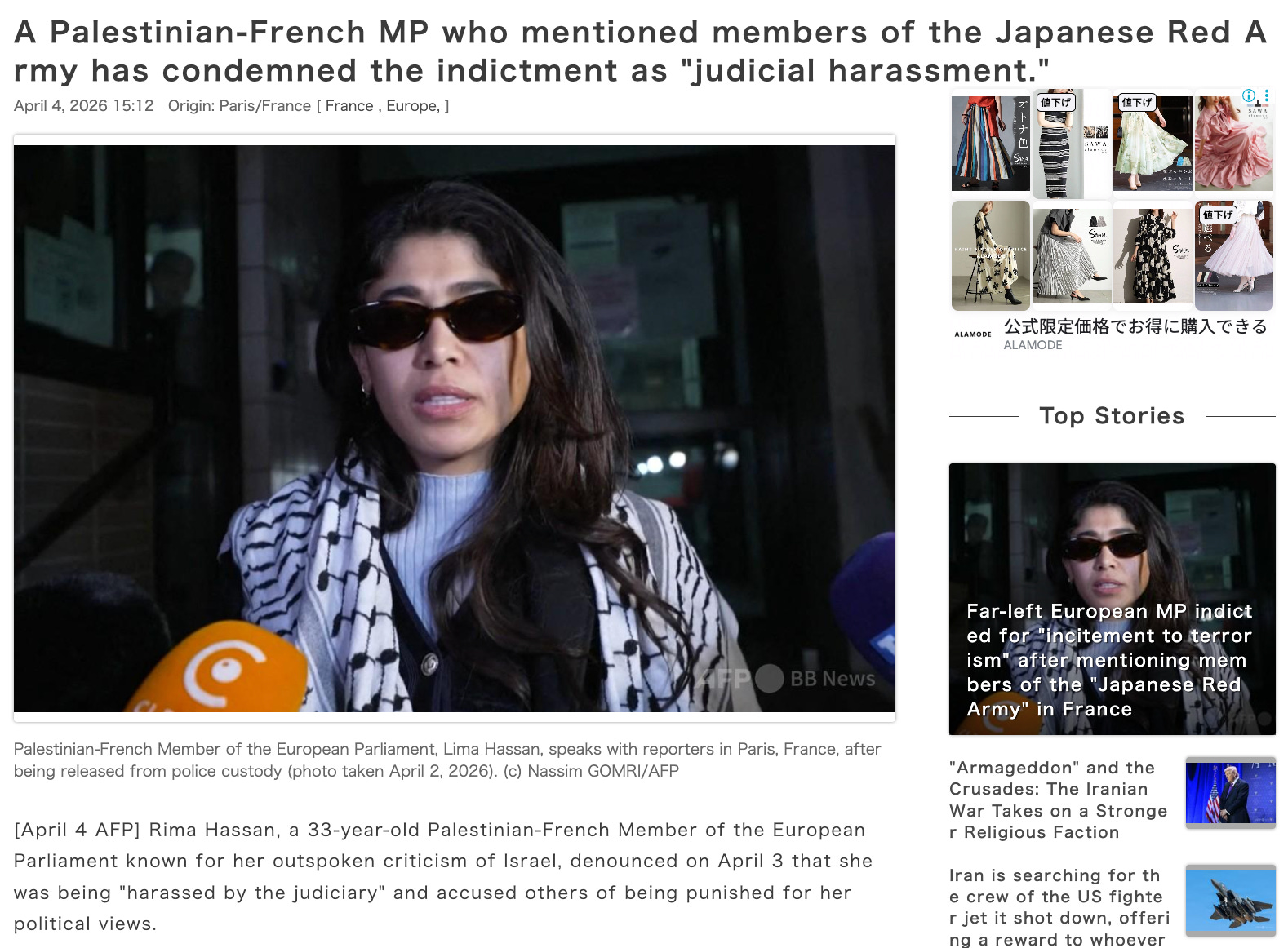
On April 2, 2026, French authorities detained Rima Hassan, a Member of the European Parliament (MEP), on charges of apologie du terrorisme (glorification of terrorism). While Hassan and her supporters have framed this as "judicial harassment" aimed at silencing her Palestinian advocacy, the legal reality for the French judiciary is grounded in a darker history of national sovereignty and spilled blood. The detention stems from her public citation of Kōzō Okamoto, a member of the Japanese Red Army (JRA)—a group that, for decades, waged a violent campaign specifically designed to dismantle democratic institutions and, most significantly, to blackmail the French state itself.
To understand why the French judiciary is taking such a hardline stance, one must look beyond the slogans to the cold, hard facts of the JRA’s criminal record and its direct attacks on France.
The Reality of the "Hero": The 1972 Lod Airport Massacre
The figure Hassan referenced, Kōzō Okamoto, was the lead executioner in the 1972 Lod Airport massacre. While Hassan’s post framed his life through the lens of “resistance” and “duty,” the historical record of May 30, 1972, tells a different story. Okamoto and two other JRA members arrived at Tel Aviv’s airport and opened fire indiscriminately into a crowd of travelers using submachine guns and grenades.
The victims were not “combatants.” Of the 26 people killed, 17 were Christian pilgrims from Puerto Rico—private citizens of a democracy who had no involvement in the geopolitical conflict. By turning a global transit hub into a slaughterhouse, the JRA didn’t just attack a state; they attacked the very concept of international safety and the democratic principle of “freedom of movement.” For an elected official of the European Parliament to present the perpetrator of this slaughter as a figure of “duty” is, in the eyes of French law, a textbook case of inciting or justifying terror.
A Direct Strike at French Sovereignty: The 1974 Hague Siege
The JRA’s conflict was never confined to the Middle East; they directly targeted French sovereign soil. In September 1974, JRA militants stormed the French Embassy in The Hague, taking the French Ambassador, Jacques Senard, and ten staff members hostage at gunpoint.
This was a calculated assault on the diplomatic immunity that allows the international order to function. The JRA successfully blackmailed the French government into releasing a jailed comrade, Yatsuka Furuya, and paying a $300,000 ransom. During the siege, two Dutch police officers were shot and seriously wounded. For the French Justice Department, the JRA represents an organization that once held the Republic’s highest representative captive. When a French MEP praises a member of such an organization, she is not merely engaging in “advocacy”; she is glorifying a group that humiliated and violated the French State.
The 1974 Paris Bombing: Blood in the Streets
The JRA’s threat to democracy extended to the streets of Paris itself. To ensure the French government’s compliance during the Hague embassy siege, the JRA’s network—including the infamous “Carlos the Jackal”—coordinated a secondary attack.
A hand grenade was thrown into the “Drugstore Publicis” shopping mall in Saint-Germain-des-Prés, Paris. Two people were killed, and 34 were injured. These were innocent shoppers, targeted specifically to force a democratic government to bypass its own laws. This tactic of “revolutionary extortion” is the antithesis of the democratic process, which relies on the rule of law rather than the barrel of a gun.
A Legal Defense of the Republic
The French Penal Code (Article 421-2-5) is clear: the glorification of those who commit such acts is a criminal offense. This law exists because the Republic believes that praising those who attack the state’s foundations—be it Ambassadors or public malls—incites further violence.
While Rima Hassan frames her detention as a crackdown on her political views, the judiciary is responding to the rehabilitation of a group that specialized in the murder of pilgrims and the kidnapping of diplomats. The JRA did not seek to “liberate”; they sought to prove that a small, violent vanguard could nullify the democratic will of millions through “blind terror.”
Conclusion
Rima Hassan currently sits in a Parliament built on the very democratic principles—sovereignty, diplomacy, and the protection of civilians—that the Japanese Red Army sought to destroy. By quoting a man like Okamoto, she touches a historical scar that the French State has not forgotten. For the authorities, this prosecution is a defense of the Republic's history and its security—a refusal to allow the architects of a 1970s terror wave to be transformed into modern social media icons.