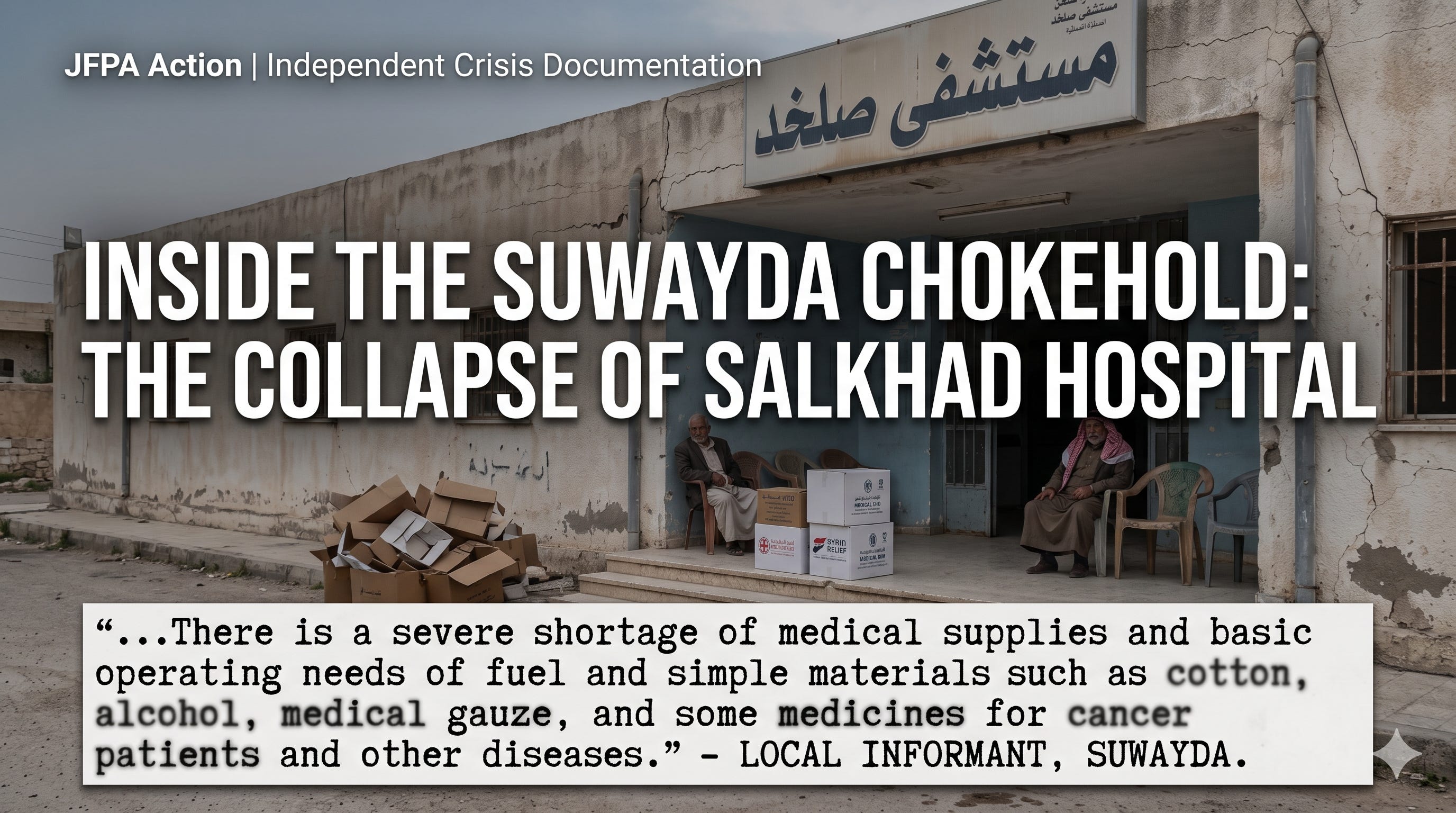
Inside the Suwayda Chokehold: The Collapse of Salkhad Hospital
A silent medical siege is systematically shutting down surgeries in Syria’s Druze-majority governorate
Dear Readers,
While mainstream international media remains focused elsewhere, a calculated, quiet siege is tightening around the governorate of Suwayda in southwest Syria. A suffocating blockade by pro-government forces and allied factions is systematically weaponizing access to basic medical infrastructure, electricity, and fuel.
The micro-level fallout is devastating. Salkhad Hospital—a critical medical lifeline for the region—has officially been forced to halt all surgical operations. The facility has been reduced to administering basic emergency first aid simply because regional checkpoints are turning away vital energy and medical shipments.
Documenting these crises in heavily censored conflict zones requires relying on secure, verified networks on the ground. We spoke directly with a local informant who described the terrifying reality of attempting to survive inside this logistical chokehold.
The barrier to saving lives isn’t a lack of medical expertise—it is the total evaporation of the most basic sterile materials. According to our source:
“There is a severe shortage of medical supplies and basic operating needs of fuel and simple materials such as cotton, alcohol, medical gauze, and some medicines for cancer patients and other diseases.”
When a major regional hospital is facing collapse not because they lack surgeons, but because they have completely run out of sterile cotton, basic rubbing alcohol, and surgical gauze, it is no longer just a logistical shortage—it is a humanitarian emergency.
Documenting these realities is only the first step toward accountability. However, independent documentation must be paired with actionable, grassroots mobilization that can securely bypass state-controlled bottlenecks.
Over on my main publication website, JFPA Action, I have published a comprehensive, uncompromised ground report detailing the structural realities of this siege. Alongside this fieldwork, I have established an independent fund to ensure direct-line civilian aid reaches trusted local relief efforts—such as the Swaida American Society—specifically to procure trauma medicines, clinic fuel, and sterile supplies.
As JFPA transitions to an independent, member-supported model, future deep-dive investigative analyses will become exclusive to our private tiers. However, this specific investigative report and the critical aid fund attached to it are entirely free and open to the public because lives are at stake.
I invite you to read the full, uncompromised ground report on my website and learn how you can support this critical fieldwork:
If you believe that independent truth requires collective action, please consider sharing this post with your network to help us break the media silence.
Yours in journalism,
Hannah Klein (Author of the JFPA article)


