

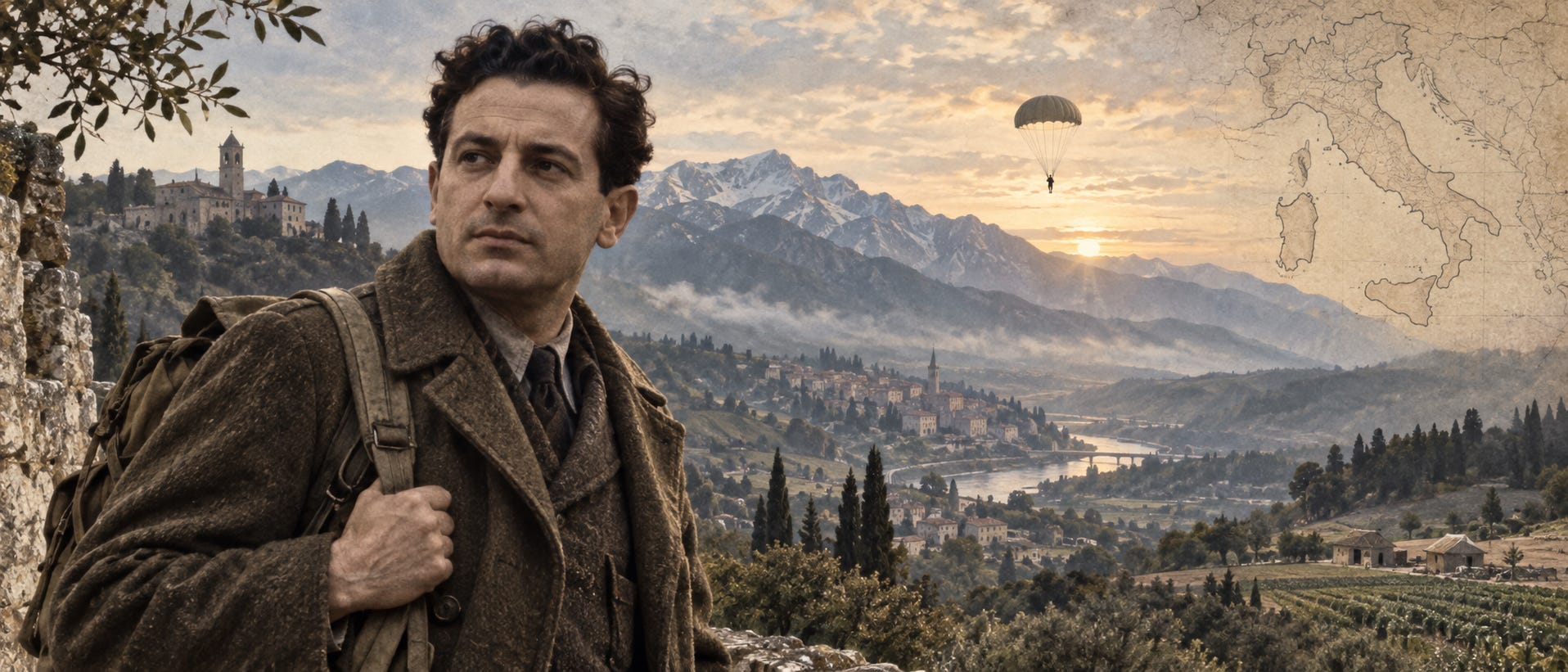
On May 15, 1944, a Jewish man descended by parachute into northern Italy.
His name was Enzo Sereni. He was thirty-nine years old, a husband and father, an intellectual, an Italian patriot, a socialist Zionist, and one of the founders of a kibbutz in Mandatory Palestine.
He did not have to return to Europe.
Sereni had already escaped the continent on which fascism was tightening its grip. He helped build a Jewish community in his people's ancestral homeland. He had meaningful work, a family, and a future.
Yet while European Jews were being hunted, deported, and murdered, Sereni volunteered to go back.
His objective was to enter German-occupied Italy, make contact with Italian partisans, support the Allied war effort, and reach Jews trapped under Nazi rule. The mission placed him among a remarkable group of Jewish volunteers from Mandatory Palestine who parachuted into occupied Europe during the Holocaust.
Sereni was captured shortly after landing. Six months later, he was murdered at Dachau.
His life poses an unsettling question: What makes a person leave safety and deliberately enter a place from which thousands of others are desperately trying to escape?
The answer lies not only in Sereni’s courage, but also in his understanding of Zionism.
For him, Zionism was not simply the dream of finding refuge. It was the responsibility to build a Jewish society capable of acting—of rescuing, defending, creating, and accepting responsibility for Jews wherever they lived.
An Italian Jew in the age of fascism
Enzo Sereni was born in Rome on April 17, 1905, into a distinguished and highly assimilated Italian Jewish family.
His father, Samuele Sereni, was a physician who served members of the Italian royal household. The family belonged to a Jewish community whose history in Italy extended back more than two thousand years.
Like many Italian Jews of his generation, Sereni inherited more than one identity. He was Jewish and Italian. He was raised in a prosperous European household, received an excellent education, and moved comfortably within Italian society.
Nothing about his childhood suggested he would one day exchange privilege for agricultural labor—or eventually parachute behind enemy lines.
Sereni encountered Zionism while still young. At eighteen, he attended the Thirteenth Zionist Congress in Carlsbad, then Czechoslovakia. The experience helped transform Zionism from an abstract idea into the organizing purpose of his life.
He did not understand Zionism merely as an escape from antisemitism. He saw it as a social and moral revolution.
The Jewish people, in Sereni’s view, needed more than physical protection. They needed the ability to shape their collective future. That required land, labor, political responsibility, cultural renewal, and a society in which Jews were not dependent upon the uncertain tolerance of rulers and majorities.
After earning a doctorate in philosophy at the University of Rome, Sereni married Ada Ascarelli. In 1927, the young couple and their infant daughter left Italy for Mandatory Palestine.
Sereni did not arrive as a wealthy European seeking comfort. He worked in the orange groves of Rehovot.
It was an extraordinary change. The son of a prominent Roman physician became an agricultural laborer under the Mediterranean sun. For Sereni, however, manual labor was not a fall in social standing. It represented participation in rebuilding Jewish national life.
In 1928, Enzo and Ada helped establish Kibbutz Givat Brenner.
The kibbutz became one of the country's largest communal settlements. It represented the Labor Zionist ideal that Jewish sovereignty had to be built through shared work, collective responsibility, and the creation of institutions—not simply through speeches or declarations.
Sereni had begun turning Zionism from philosophy into practice.
A Zionism larger than refuge
It would be easy to describe Sereni only as a pioneering Zionist. But his political thought was more complicated and more interesting than a simple heroic label suggests.
He was a socialist and an opponent of fascism. He believed in Jewish national renewal, yet he also supported cooperation and coexistence between Jews and Arabs.
He was known as a pacifist. During the Arab revolt of the 1930s, accounts of his life describe him performing guard duty without carrying a weapon.
That detail captures one of the contradictions at the center of Sereni’s life. He wanted peace, but he lived in an age that repeatedly demanded confrontation. He opposed violence, yet he eventually volunteered for an extraordinarily dangerous military mission.
This did not necessarily mean that Sereni abandoned his earlier principles. It meant that he recognized a difference between glorifying force and resisting a regime committed to conquest and genocide.
His Zionism was neither passive nor narrowly territorial. Establishing a Jewish home in Mandatory Palestine did not release him from responsibility toward Jews elsewhere. On the contrary, possessing a secure base created new obligations.
A Jewish community capable of organizing farms, unions, schools, and defense forces could also train emissaries, assist refugees, confront fascist propaganda, and send help into occupied Europe.
For Sereni, Jewish self-determination meant Jewish responsibility.
Returning to a darkening Europe
During the early 1930s, Sereni returned to Europe as a Zionist emissary.
The continent he encountered was moving rapidly toward catastrophe. Adolf Hitler became German chancellor in January 1933. The Nazi regime began excluding Jews from professional, cultural, and public life while flooding German society with antisemitic propaganda.
Sereni worked with the Hechalutz movement, which trained young Jews for agricultural life in Mandatory Palestine. He helped prepare prospective immigrants and supported efforts to move Jewish people and resources out of Germany.
He was briefly detained by the Gestapo.
Sereni possessed something that many European Jews urgently needed: a destination and an organized movement capable of helping them reach it. The communities being built in Mandatory Palestine were no longer only a Zionist aspiration. They were becoming possible places of rescue.
This is one reason Sereni’s story matters to any serious discussion of Zionism and the Holocaust.
Zionism did not begin because of the Holocaust; the modern political movement had emerged decades earlier. But the Nazi rise to power demonstrated the deadly danger of permanent Jewish dependence on other governments.
Doors around the world were closing to refugees. Immigration restrictions prevented countless Jews from finding safety. Appeals to conscience were repeatedly subordinated to domestic politics, bureaucracy, and indifference.
Sereni understood that a people without control over immigration, defense, or national policy could plead for refuge but could not guarantee it.
That realization did not turn him away from Europe’s Jews. It drove him back toward them.
Fascism reaches Italian Jews
Italian Fascism initially differed from Nazi racial ideology in significant ways, and Jews remained integrated into Italian public life during the regime’s early years. Some Italian Jews even joined the Fascist Party.
That history can obscure what followed.
Beginning in 1938, Benito Mussolini’s government imposed antisemitic racial laws. Jews were removed from public employment and education, excluded from the armed forces, subjected to restrictions on marriage, and pushed out of important areas of Italian life.
The laws announced that even deeply rooted, culturally integrated Italian Jews could be reclassified as outsiders.
In September 1943, Italy’s surrender to the Allies brought an even more dangerous transformation. German forces occupied northern and central Italy, rescued Mussolini, and installed him as head of the collaborationist Italian Social Republic.
Under German occupation, persecution escalated into arrest and deportation. Nazi authorities and their collaborators rounded up Jews in Rome, Milan, Florence, Genoa, Trieste, and other cities. Transit camps were established to imprison people before deporting them, principally to Auschwitz-Birkenau.
The country of Sereni’s birth had become a battleground. Italian partisans fought the German occupation and Mussolini’s remaining forces. Jews went into hiding, joined resistance formations, sought escape routes, or depended upon neighbors and strangers willing to risk their own lives.
Sereni could not remain an observer.
The Jewish parachutists
During the Second World War, Sereni joined the British Army and took part in antifascist activity in Egypt. He also worked in Iraq, where he supported Zionist organizing and clandestine Jewish immigration to Mandatory Palestine.
He later helped organize a parachute unit created through cooperation between British authorities and the Jewish Agency.
Hundreds volunteered. More than one hundred reportedly received some degree of training, but only a small number were ultimately sent into occupied Europe.
Their assignment combined several objectives. They were expected to assist Allied intelligence and military operations, contact local resistance movements, and, where possible, reach endangered Jewish communities.
The two purposes did not always fit comfortably together.
Britain’s primary concern was winning the war. The Jewish volunteers were also driven by the desire to reach Jews facing annihilation. Military planners evaluated missions strategically; the volunteers carried a sense of national and personal obligation.
The group included several figures who would become symbols of Jewish resistance, including Hannah Senesh and Haviva Reik.
Sereni was older than many of the other volunteers. At thirty-nine, he had a wife, children, and significant responsibilities. He was not a young person searching for adventure. He understood both the mission's danger and the life he might lose.
Because he was a senior organizer, Sereni could have stayed behind. He could have argued that his experience made him more valuable as a planner, recruiter, or political representative.
Instead, he insisted on going.
His decision gave moral weight to the program he had helped create. Sereni would not ask younger volunteers to accept a danger that he was unwilling to face himself.
